


- Written by: arvedamultiventures@gmail.com
- September 1, 2026
Building Partnerships for Community Development (CSR Collaboration)
Sustainable social change is rarely achieved by a single organization working alone. It requires collaboration — between government bodies, corporates, industries, educational institutions, and grassroots organizations, all working toward shared goals. This belief lies at the core of our approach to community development.
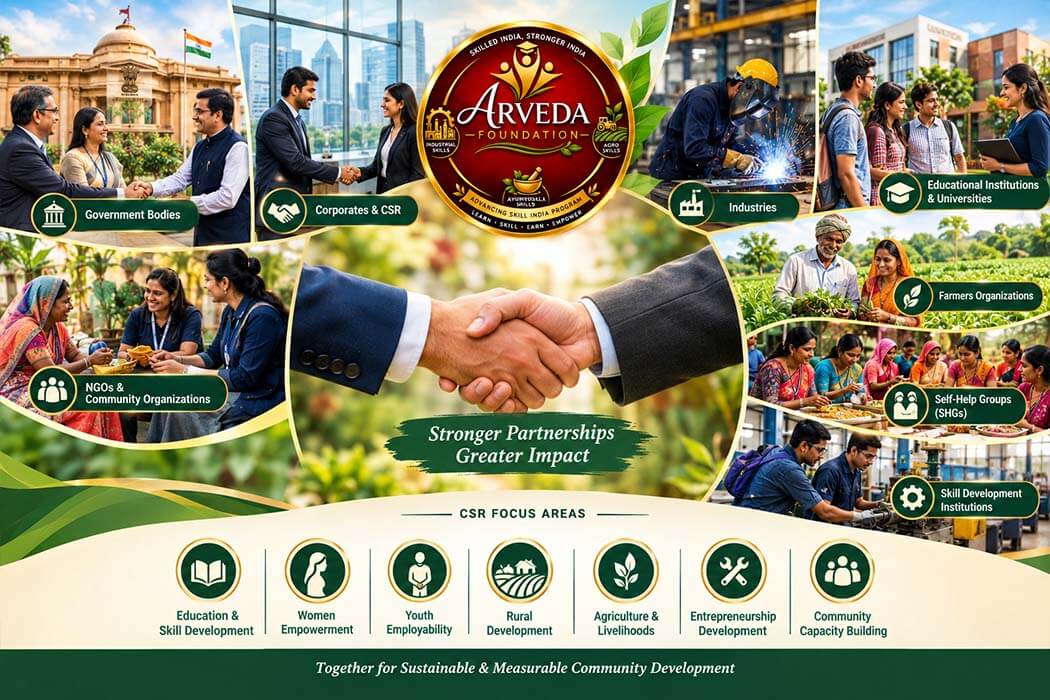
We actively seek and welcome partnerships with a wide range of stakeholders, including government authorities, CSR organizations, industries, universities, educational institutions, NGOs, self-help groups, farmer organizations, and skill development institutions. Each of these partners brings unique strengths — funding, technical expertise, market access, or community trust — that, when combined, create a far greater impact than any single organization could achieve alone.
For corporates and CSR organizations specifically, we offer structured opportunities to invest in measurable, community-oriented outcomes across several key areas: education and skill development, women empowerment, youth employability, rural development, agriculture and livelihoods, entrepreneurship development, vocational training, and community capacity building.
Our approach to CSR collaboration is built on structured programme implementation. Rather than one-off initiatives, we design programmes with clear objectives, defined beneficiary groups, and measurable outcomes — ensuring that CSR investments translate into real, trackable community impact rather than just activity for its own sake.
We also believe strongly in stakeholder collaboration throughout the programme lifecycle — from initial design through implementation and evaluation. This ensures that programmes remain grounded in actual community needs, rather than being designed in isolation and imposed from the top down.
Government partnerships play an equally important role in our work, helping us align our initiatives with broader public policy goals around skill development, rural development, and employment generation. These partnerships often help us scale successful programmes to reach more beneficiaries across wider geographies.
Educational institutions and universities contribute valuable technical and academic expertise, helping us continuously refine and improve the quality of our training programmes. Meanwhile, self-help groups and farmer organizations provide the grassroots connections essential for reaching communities effectively and building trust at the local level.
We invite government bodies, corporates, CSR teams, industries, and educational institutions to explore collaboration opportunities with us. Together, through structured partnerships and shared commitment, we can create sustainable, measurable social and economic impact — building skills, creating opportunities, and empowering communities at scale.